
THE DOUBLE WITNESS
Anomaly State Chaptisode 24: The Double Witness
Published: December 9, 2025 SAST. UTC +2
A Serialized Cinematic-Fiction Experience · SoapNovel Studios
First-time here? Start at Chaptisode 1
Previously in Anomaly State
03:14 SAST — Pretoria
Security Officer Luthuli had worked the east vestibule of the Union Buildings for seven years. He had seen restless ministers, late ministers, ministers who arrived half-drunk or half-awake, ministers who panicked at misplaced lanyards and ministers who pretended their own power exempted them from protocol.
He had never seen two of the same one.
The first Minister Radebe approached through the north corridor, suit crisp, shoes quiet on the polished floor. He nodded as he passed the checkpoint.
“Early call?” Luthuli asked.
“Briefing on the Window projections,” Radebe replied. “They said I was needed before dawn.”
He walked toward Conference Annex 3.
Nothing unusual.
Nothing yet.

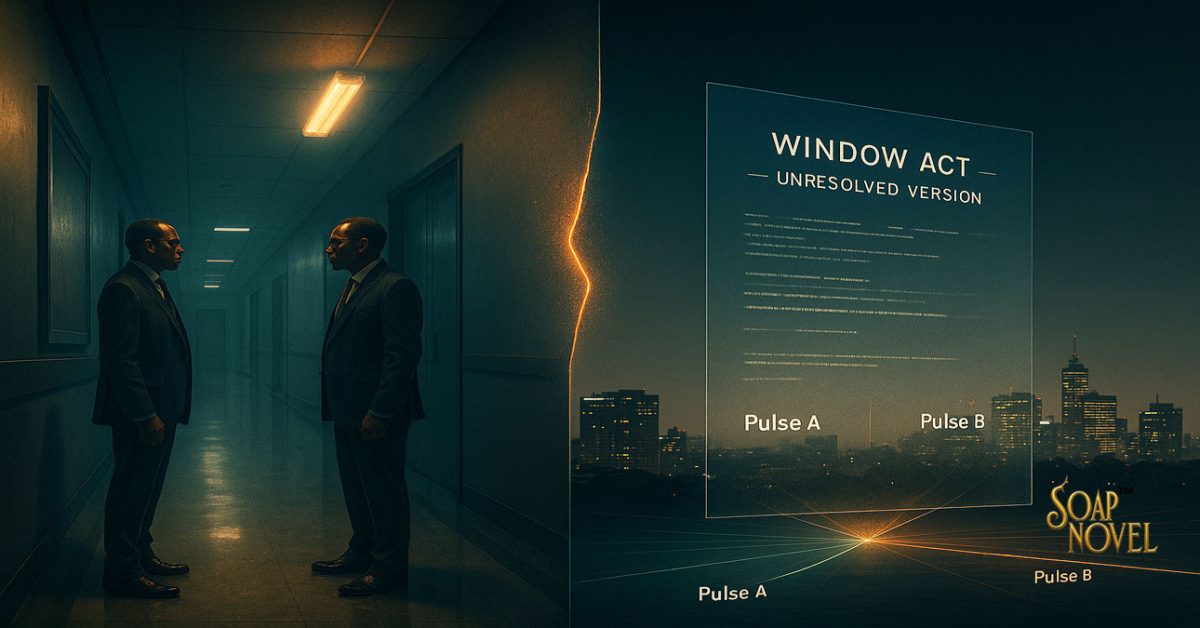
Exactly forty-three seconds later, the same footsteps approached from the opposite hallway.
Luthuli turned, expecting perhaps an aide or junior analyst.
He saw Radebe again.
Same suit. Same briefcase. Same expression—except this one looked slightly more tired, as if he had been awake longer than the city itself.
“Morning,” Luthuli managed.
Radebe blinked. “I checked in already.”
“No, sir. You didn’t.”
“I came through here,” Radebe said, pointing at the north corridor.
But he was standing in the south.
Before Luthuli could respond, the first Radebe entered the vestibule again, retracing his steps in reverse—as if summoned by the presence of his duplicate.
The two men stared at each other.
Not mirrored.
Not synchronized.
Two versions of the same life, occupying the same air.
Minister A spoke first. “What briefing is this?”
Minister B answered: “The one you already attended.”
Though neither had.
Luthuli took a step back. “Gentlemen… which one of you is—”
Both said:
“I am.”
The corridor lights flickered.
Not amber.
Not white.
A faint prismatic vertical seam snapped open behind them, then closed as if startled.
Pretoria had recorded its first Double Witness Event.
II. Cape Town — The Window Act Shifts Again
Mara liked her screens dim. Not out of aesthetic moodiness, but because dimness told the truth: light reveals, yes, but also distorts. Darkness removes the urge to pretend clarity.
She tapped open the classified draft.
Clause 12 had expanded again, without revision history.
Clause 5 had reversed itself—a sentence that once advised caution now read like a preemptive justification.
Clause 1 no longer resembled the language of the department that originally authored it. It read sharper, almost anticipatory, as if someone had rewritten it with the confidence of having already seen the outcome.
Her deputy, Tomas, leaned over her shoulder. “That clause wasn’t there yesterday.”
“It was,” Mara said. “Just not in this order.”
“You’re telling me the draft reorganized itself?”
“No.” Mara scrolled slowly, each motion deliberate. “I’m telling you it’s negotiating.”
Tomas frowned. “Negotiating with who?”
“Not with us,” she said.
The screen vibrated—softly, like breath against a window. Clause 12 pulsed faintly.
A message flickered across the bottom edge:
THIS VERSION IS NOT FINAL.
“We didn’t write that,” Tomas whispered.
“I know,” Mara replied. “The anomaly did.”
III. Johannesburg — The Fractured Speech
The emergency gathering inside Conference Hall C felt like a summit pretending it wasn’t unraveling. Delegates whispered as much about the anomaly as they did about the political bombshell detonated the night before:
Trump had announced South Africa would not be invited to the Miami G20 in 2026.
The fallout arrived faster than security clearance badges.
“This is Berlin 1884 in digital clothing,” murmured Ghana’s envoy.
Kenya’s representative shook his head. “No. It’s worse. That was partition. This is erasure.”
Senegal added quietly: “Or performance. Someone wants us to see lines where there are none.”
Then came the real fracture:
Every delegate recalled a different version of Trump’s statement.
Mozambique recalled a tone of disdain.
Portugal (observing) recalled a tone of apology.
Tanzania insisted the speech was shorter—thirty-nine seconds at most.
Uganda swore it ran for more than two minutes and mentioned Ethiopia twice.
South Africa’s own minister said he remembered no broadcast at all—only a written communiqué.
“You’re telling me we didn’t all watch the same speech?” snapped the Kenyan envoy.
Ghana replied: “We didn’t even watch the same moment.”
Their translators compared footage from each delegation’s feed.
No two videos matched.
Lighting, background noise, Trump’s tie color—everything differed.
A diplomat whispered what none wanted to admit:
“The anomaly edited the perception of a global leader.”
IV. Nairobi — The Room That Happened Twice
The analysts entered Briefing Chamber 4 at 10:02.
Nine of them.
A routine operational review.
At 10:02:16, the door opened again—revealing the same analysts entering a second time, but without the woman assigned to seat 4.
Both groups looked at each other.
Seat 4’s version of her whispered: “I’m here. You’re… not me.”
The version missing from the second group stepped backward as if someone had shoved her through time.
An analyst checked the system logs. “We have three versions of your entry.”
“How is that possible?” she asked.
“That depends which timeline survives,” he murmured.
She put a hand on the table to steady herself.
Cold surface.
Metal.
Real.
But reality now had options.
V. Cairo — The Glyph That Watched Back
The Cairo anomaly lab had been silent for three days—silent enough to make the watching feel worse than the noise.
The primary wall glyph, etched into the stone fragment recovered years prior, rotated again.
But this time the motion was intentional.
It turned directly toward Technician Youssef.
“Stop moving,” the lead researcher hissed.
“I’m not moving,” Youssef whispered.

The glyph continued to pivot, aligning itself with the angle of his gaze.
A second glyph appeared beneath it—thin, mirrored, pulsing faintly.
“What is that?” another tech asked.
The lead swallowed. “Parallel instruction set.”
“For what?”
“For something that wants two versions of the same command.”
The anomaly was building a second linguistic frame, a partner to the first.
VI. Cross-Continental Dual Pulse
16:40 SAST.
All stations logged a synchronized distortion event.
Durban: Pulse A detected.
Pretoria: Pulse B detected.
Johannesburg: Pulse A with faint Pulse B echo.
Nairobi: Pulse B only.
Cairo: Pulse A → Pulse B, 0.9 seconds apart.
Dubai: unreadable interference.
Tokyo: Both pulses recognized as primary.
Two anomalies.
Two pulses.
Two interpretations of the same world.
VII. Pretoria — Double Witness Interrogation
Both Radebes were escorted to separate interview rooms.
Minister A sat rigid. “I remember the Window Act still in advisory phase.”
Minister B sat relaxed. “Not in my version. You approved it two days ago.”
“That’s impossible!” Minister A snapped.
“Is it?” Minister B tilted his head. “I also remember the Miami G20 corridor meeting.”
“There is no such meeting!”
“Not for you,” said Minister B. “Yet.”
The interviewer swallowed. “Minister B, how do you know what I’m about to ask next?”
Minister B exhaled slowly. “Because I remember this conversation. The one we’re in. I remember your tone, your pause, your disbelief.”
“This conversation hasn’t happened yet.”
“In your version,” Minister B replied softly. “Not mine.”
VIII. Cape Town — The Second Lattice Reveals Itself
Mara pulled the overlays up on her screen—corridor distortions, timestamp divergences, perceptual conflicts, room resets, glyph rotations.
When layered, a new pattern emerged:
A shadow lattice, offset from the primary anomaly’s geometry by 0.01 cm, nearly invisible unless viewed sideways.
Tomas leaned close. “Is it multiplying?”
“No,” Mara said. “It’s rehearsing.”
“For what?”
“A second position.”
“A second who?”
Mara didn’t answer.
She didn’t need to.
The monitors flickered:
TWO OBSERVERS DETECTED
IX. Closing Scene — The Protocol Splits
City lights blinked in Durban, Cairo, Pretoria, and Nairobi simultaneously.
Every active terminal went black.
Then white.
Then black again.
Then two messages appeared:
PROTOCOL A:
THE WINDOW ACT IS APPROACHING.
PROTOCOL B:
THE WINDOW ACT HAS ALREADY BEGUN.
The delay: 0.9 seconds.
Identical structure.
Different temporal origin.
The anomaly had become two.
Two witnesses.
Two narratives.
Two futures preparing to diverge.
And only one reality could survive the split.
After the Signal.
If this story resonates with you, consider supporting the protocol with a small Bitcoin donation. Every satoshi counts in keeping the signal strong—share and enjoy!
You’re reading Anomaly State — a serialized political fiction saga.
🔗 Bitcoin Address: 3NM7AAdxxaJ7jUhZ2nyfgcheWkrquvCzRm
English
You’re reading Anomaly State — a serialized political fiction saga.
Although satirical and fictional, TrumpaPhosa carries a thread of purposeful prophecy and hidden revelation. Some readers may interpret it as a roadmap — a reflection of what is, what was, and what may yet come.
Zulu (isiZulu)
Ufunda Anomaly State — uchungechunge lwenganekwane yezepolitiki.
Nakuba kungukuhleka nokuyinganekwane, iTrumpaPhosa ithwala umqondo wokuphrofetha ngenhloso kanye nokudalulwa okufihlekile. Abanye abafundi bangakuhumusha njengemephu yomgwaqo — ukubonakaliswa kwalokho okukhona, okwedlule, nokungenzeka kusasa.
© 2025 Soapnovel.sbs. All rights reserved. 版权所有
This serialized work is protected under creative content provisions and monitored by the Protocol.
Registered for satirical transmission worldwide.