

The Non-Linear Room
Anomaly State Chaptisode 23: The Non-Linear Room
Published: December 2, 2025 SAST. UTC +2
A Serialized Cinematic-Fiction Experience · SoapNovel Studios
First-time here? Start at Chaptisode 1
I. The Corridor That Refused to Stabilize
Pretoria’s administration wing had always obeyed architecture.
Even during the anomaly’s earliest disturbances—
the lagging reflections, the prismatic shivers, the pre-echo footsteps—
its corridors still behaved like corridors.
Until today.
Minister Khumalo stepped into the hallway and felt reality loosen.
The amber ceiling line flickered, not forward or backward, but sideways,
as if time had slipped diagonally across her vision.
Her reflection in the glass panel remained three steps behind.
Not lagging.
Choosing to remain behind.
A soft click echoed—a door closing somewhere ahead.
But the corridor in front of her remained empty.
Nothing had closed.
Nothing had moved.
She whispered into the stillness:
“Not again.”
But it was not “again.”
This was new.
The corridor extended itself.
Just one centimeter.
Barely visible.
Just enough for the human eye to register that space had grown where space shouldn’t.
It was learning.
II. Johannesburg: The Summit That No Longer Agreed With Itself
Delegates stepped into Conference Room D at the summit.
A practical space—triangular table, four cameras, simultaneous translation.
But today, the room was having an identity crisis.
Three separate groups of delegates—entering at the same time—described the room in three different ways:
- Group A: “Gray walls. No windows.”
- Group B: “Large window overlooking the plaza.”
- Group C: “Circular layout. No corners.”
All three insisted they were correct.
All three had time-stamped photos supporting their version.
The photos disagreed with each other.
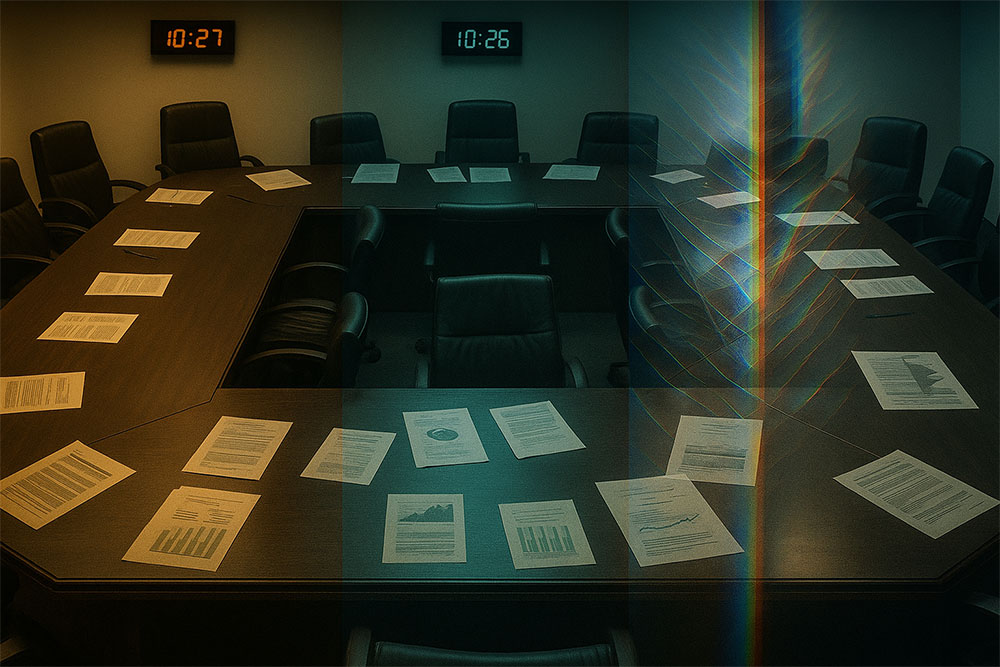
A Nigerian minister stared at the room’s live feed on the wall monitor and said:
“This isn’t a glitch.
This is choice.”
The Ethiopian delegate beside him nodded, refusing to look at the cameras again.
Outside, the Johannesburg skyline pulsed faintly—
a prismatic ripple that nobody could explain and everyone tried not to notice.
III. Cape Town: The Document That Rewrote Itself
Mara had just finished rereading the Convergence Draft when it happened again.
Clause 5 flickered.
The paragraph she had just read—
clean, clear, about “temporal coordination”—
dissolved and reassembled into something else:
“Perception shall precede verification.”
“What does that even mean?” she muttered.
Her deputy looked over her shoulder.
“That wasn’t there before.”
Mara nodded.
She pulled out her printed copy of the same document from two days earlier.
Clause 5, printed, read:
“Verification must precede all perceptual analysis.”
The exact opposite.
She felt the shift.
Not a glitch.
Not corruption.
A revision. Live.
The anomaly was no longer distorting documents.
It was editing them.
And Mara was increasingly convinced the changes were intentional.
IV. Nairobi: Two Timestamps, One Reality
The Nairobi Data Relay Center handled thousands of threads a day.
It was the continent’s most stable node.
Until at 11:14:03 SAST, the main console froze.
Technician Kiprotich stared at the screen.
Two identical logs had appeared.
Both from Johannesburg.
Both marked “Arrival Confirmed.”
Both from the same camera feed.
Both containing the same delegate silhouette.
But one was timestamped:
11:14:03.002
The other:
11:14:02.998
The difference was minuscule.
But it meant one thing:
The same event had been reported before and after itself.
Kiprotich rubbed his temple and whispered:
“Which one is real?”
The senior analyst replied:
“…Both.”
And that scared everyone.
V. Cairo: The Glyph That Looked Back
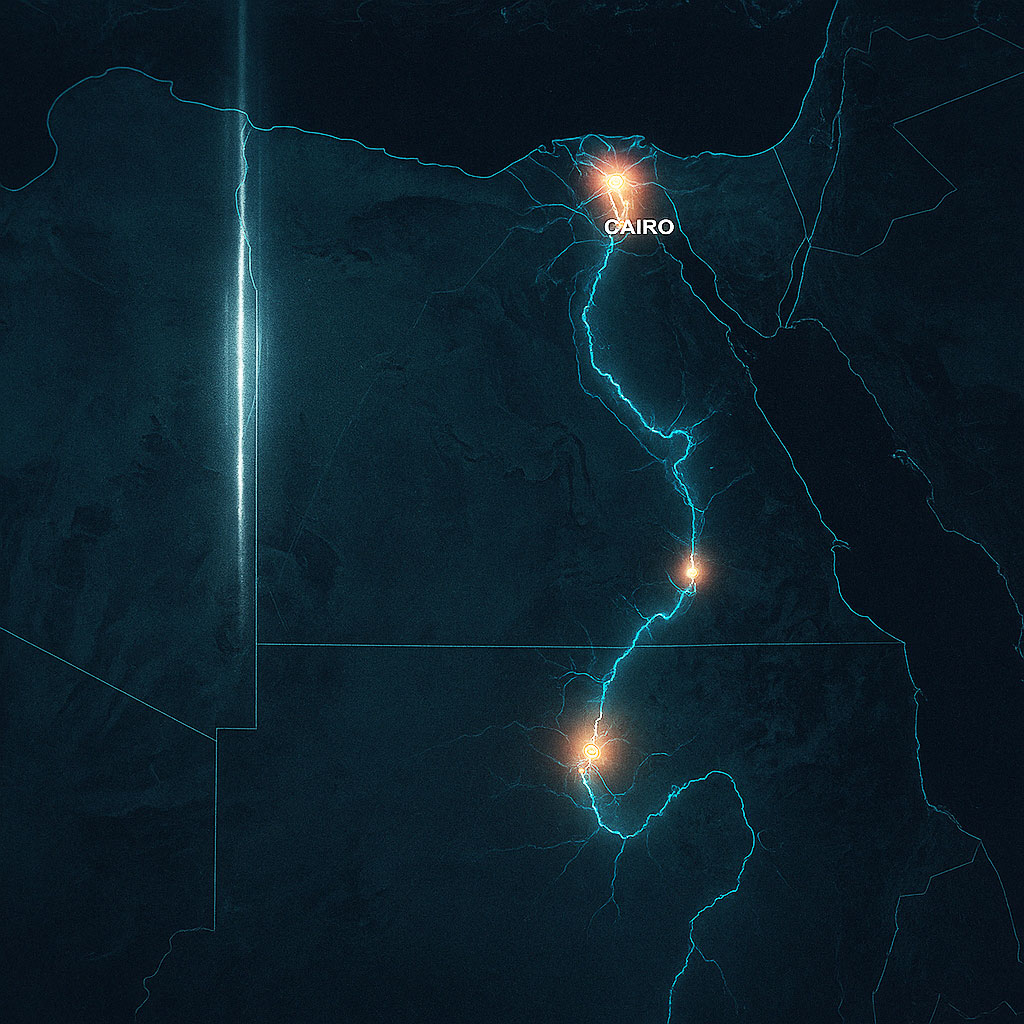
In Cairo’s electromagnetic lab, the hybrid alphabet—introduced during the Nile events—glowed faintly on the wall display.
Then the largest glyph shifted.
Not rotated.
Turned.
To look toward the viewers.
A cold weight dropped through the room.
Technicians backed away, one whispering:
“Language doesn’t… observe.”
Another technician, trying to remain clinical, typed:
OBSERVATION: GLYPH APPEARS TO HAVE ADOPTED POINT-OF-VIEW LOGIC.
But the glyph was not done.
It split.
The upper half drifted upward into a corridor shape.
The lower half folded into a silhouette—vaguely human, vaguely seated.
Something clicked in the back of Mara’s mind.
Leadership posture.
Meeting posture.
A chair.
The silhouette was learning hierarchy.
VI. Pretoria: The Room That Did Not Exist Yesterday
Minister Motaung rushed into the cabinet suite—and stopped cold.
At the end of the hallway was a room he had never seen before.
No door.
Just an opening.
A rectangular frame cut cleanly into the wall.
Inside:
a spare, minimalist chamber
with a long obsidian table
and a single line of prismatic light along the ceiling
pulsing at 4.3-second intervals.
He pulled up the building’s internal blueprint.
No such room existed.
He took one step inside—
—and the walls breathed.
Inward.
Outward.
Like the room was inhaling him.
He staggered backward into the hallway.
The prismatic ceiling flickered once.
When he looked again—
—there was only a smooth corridor wall.
The room was gone.
A disappearing chamber.
A non-linear room.
A space temporarily edited into reality.
The anomaly was manipulating architecture now.
VII. Johannesburg: Delegates Hear Different Minutes
During a high-level briefing, the lead interpreter suddenly froze.
She looked at the delegates and asked:
“Which one of you just asked that question?”
No one had spoken.
A Swedish delegate raised her hand slowly.
“I heard a question. In English.”
A Ghanaian advisor frowned.
“I heard nothing.”
A Brazilian diplomat leaned forward.
“I heard two versions of the same question.”
The interpreter checked her transcript pad.
The device had automatically recorded:
Q1: “Is the Window Act now in effect?”
Q2: “Is the Window Act now a factor?”
Two different phrasings of a question that had never been asked.
The interpreter whispered:
“It’s speaking through us.”
VIII. Pretoria: The Minister Who Arrived Twice
Minister Khumalo burst into the cabinet room.
The others stared.
She scanned their faces.
“What?”
Minister Radebe leaned forward.
“You were already here five minutes ago.”
“No, I wasn’t.”
“Yes,” he said softly.
“You walked in.
You sat there.
You wrote something down.
We watched you do it.”
Khumalo felt her stomach twist.
“I was five floors down in a security meeting.”
No one spoke.
Then Minister Lira pointed to the table.
A sheet of paper lay there.
Khumalo’s handwriting.
Her signature.
Her date.
But she had never written it.
And the worst part:
It was timestamped five minutes in the future.
She whispered:
“Which version am I?”
No one answered.
IX. The Cross-Continental Echo
At 16:40 SAST, Cairo, Nairobi, Johannesburg, Dubai, and Tokyo all reported the same anomaly:
A faint corridor-shaped distortion appeared for exactly 0.7 seconds.
Then it split—
Two identical distortions
one above the other
mirrored
synchronized
…but slightly out of phase.
A Cairo analyst said:
“That’s a duplicate signal.”
A Johannesburg technician replied:
“No.
That’s a vector test.”
A Tokyo researcher whispered:
“It’s preparing for a second anchor point.”
No one dared speak the implication:
The anomaly was considering binary division.
X. Cape Town: The Revision That Shouldn’t Happen
Mara returned to her office.
The Convergence Draft was open on her screen.
But Clause 12—long dismissed as meaningless—
had rewritten itself again.
This time it read:
“When observation fails,
a second vantage is required.”
Her blood chilled.
The anomaly wasn’t fragmenting.
It was preparing.
Preparing for what?
A second version of itself?
A second presence?
A second host?
The draft offered no answers.
Only architecture.
XI. The Non-Linear Room Reappears
In Pretoria, Minister Motaung walked past the architectural wall.
The non-existent room appeared again.
This time, a single object rested on the table:
A blank page.
He stepped inside.
The walls breathed once.
The page flickered, revealing faint gray text:
WINDOW ACT — DRAFT OF THE SEEN AND UNSEEN
CLAUSE 0.0 — “THE HINGE DIVIDES.”
And then the room vanished.
XII. Closing Line — Signal Lost
“The anomaly was no longer interpreting the continent.
It was beginning to interpret itself.”
— Signal Lost
If this story resonates with you, consider supporting the protocol with a small Bitcoin donation. Every satoshi counts in keeping the signal strong—share and enjoy!
You’re reading Anomaly State — a serialized political fiction saga.
🔗 Bitcoin Address: 3NM7AAdxxaJ7jUhZ2nyfgcheWkrquvCzRm
English
You’re reading Anomaly State — a serialized political fiction saga.
Although satirical and fictional, TrumpaPhosa carries a thread of purposeful prophecy and hidden revelation. Some readers may interpret it as a roadmap — a reflection of what is, what was, and what may yet come.
Zulu (isiZulu)
Ufunda Anomaly State — uchungechunge lwenganekwane yezepolitiki.
Nakuba kungukuhleka nokuyinganekwane, iTrumpaPhosa ithwala umqondo wokuphrofetha ngenhloso kanye nokudalulwa okufihlekile. Abanye abafundi bangakuhumusha njengemephu yomgwaqo — ukubonakaliswa kwalokho okukhona, okwedlule, nokungenzeka kusasa.
© 2025 SoapNovel Studios — Part of the SoapVerse Network. All rights reserved. 版权所有
This serialized work is protected under creative content provisions and monitored by the Protocol.
Registered for satirical transmission worldwide.